

ICE tightened I-9 compliance — here's what employers need to know
ICE recently updated its I-9 enforcement guidance, increasing scrutiny on common errors and electronic I-9 compliance requirements. Here’s what employers need to know about what's changed.
Last Updated: September 10, 2026
August 2026 update
ICE updated its I-9 inspection guidance again on August 31. The update does not roll back the March changes that made many common errors substantive, nor does it create new I-9 requirements. Instead, it gives employers a clearer picture of what ICE may look at during an audit and how different violations could affect penalties.
- Earlier guidance said that failing to meet the requirements for an electronic I-9 system under 8 C.F.R. § 274a.2(e)-(i) could count as a substantive violation. The August update now specifically says electronic systems must be able to produce readable copies with a “compliant audit trail.” This signals that ICE may look beyond the completed I-9 and review the form’s history, including how it was created, signed, corrected, and retained.
- ICE also added a new notice for employees who lose work authorization. The “Notice of Expired or Rescinded Immigration Status and/or Employment Authorization” tells employers when an employee has lost work authorization between the audit and when the notice is issued. The notice itself does not mean ICE is alleging employer wrongdoing. Still, it gives employers a clear trigger to promptly review the employee’s current work authorization and determine what action is needed.
- The March guidance combined paperwork violations with knowingly hiring or continuing to employ violations when calculating the violation percentage used for penalties. The August update says ICE will now calculate these separately: one percentage for substantive or uncorrected paperwork violations and another for knowingly hiring or continuing to employ violations. Depending on audit findings, separating the categories can change the base penalty calculation.
March vs. August 2026 update
March update
Substantive violations list
Cure period
Penalty calculation
Electronic I-9 focus
Work authorization loss
March 2026 update
On March 16, U.S. Immigration and Customs Enforcement (ICE) released an updated fact sheet outlining how I-9 inspections are conducted and how violations are assessed. While positioned as guidance, the update reflects a meaningful shift in how compliance is evaluated and enforced.
Most notably, ICE has redefined the line between technical and substantive violations, reclassifying several common errors that were historically correctable into substantive violations subject to immediate fines. This change significantly reduces employers' ability to fix issues after the fact and increases exposure for routine mistakes.
The guidance also formalizes new technical violations — errors that previously had no classification and no associated penalty are now codified as enforceable infractions.
In parallel, the guidance reinforces heightened scrutiny on electronic I-9 systems, signaling that employers are accountable not only for form completion but also for whether their systems:
- Enforce required fields and timing rules
- Maintain compliant audit trails
- Properly capture and track corrections
- Meet federal standards for electronic signatures and recordkeeping
As a result, I-9 compliance is shifting from a process-driven obligation to a system-level responsibility, where both human error and platform design can create liability.
Overall, this release is widely interpreted as a signal of stricter, more standardized enforcement, with increased focus on scalability, consistency, and the defensibility of employer compliance programs.
New substantive I-9 errors
Several commonly correctable I-9 errors are now treated as substantive violations under the updated ICE guidance. Find the official Form I-9 error guidance from ICE here.
*For informational purposes only and not intended as legal advice. Consult legal counsel for specific guidance.
Error
New technical I-9 violations
Several previously unclassified I-9 errors are now treated as technical violations under the updated ICE guidance. Find the official Form I-9 error guidance from ICE here.
*For informational purposes only and not intended as legal advice. Consult legal counsel for specific guidance.
Error
Key actions for employers
To stay aligned with the updated ICE I-9 guidance, employers should prioritize both system controls and day-to-day I-9 processes.
Software compliance:
- Review electronic I-9 system compliance and audit trails
- Strengthen Section 2 review and completion controls
- Review remote verification + E-Verify workflows
- Automate reverification and rehire tracking
People and processes:
- Audit existing I-9s for newly substantive and technical errors
- Retrain HR teams on updated enforcement standards
- Standardize I-9 processes across teams and locations
Looking for a little help?
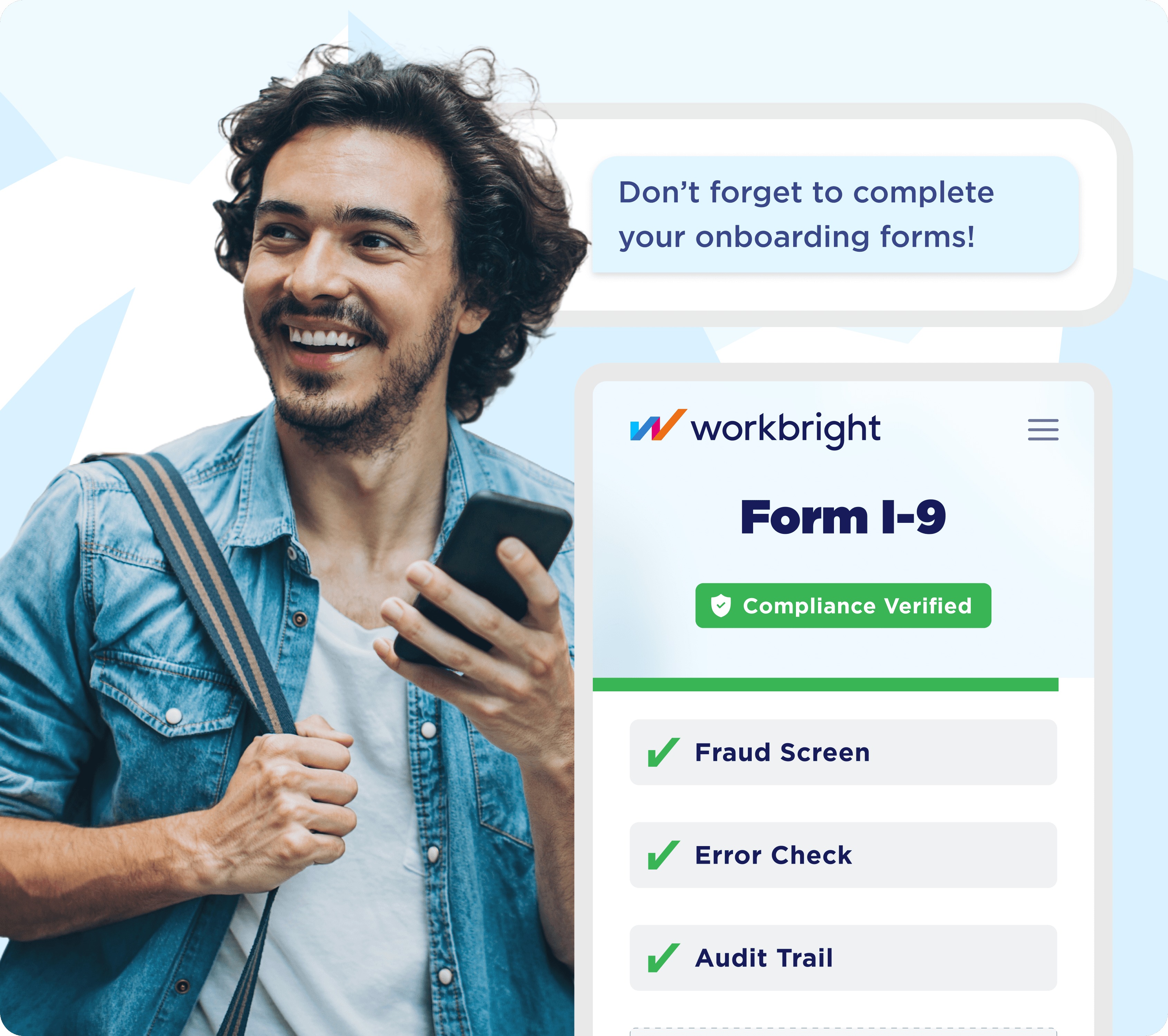
WorkBright is built to manage the complexities of evolving compliance guidance. Our software and services reduce errors, prevent document fraud, and keep your records audit-ready — so substantive violations never make it into your files.
Real-time I-9 validation
150+ automated compliance checks catch missing DOBs, hire dates, and employer titles before submission.
- Required fields enforced at every step
- OCR-assisted document transcription
- Pre-submission compliance checks
Audit-ready electronic I-9 platform
In addition to audit services, our platform supports compliant electronic I-9 completion, retention, and recordkeeping.
- Immutable, timestamped audit trail
- Tamper-evident e-signatures
- Built-in retention rules
Flexible Section 2 + E-Verify
WorkBright supports all Section 2 completion methods, plus built-in E-Verify that resolves 95% of cases instantly without switching platforms.
- Supports in-person, remote, and the alternative procedure Section 2
- Built-in checkpoint for the alternative procedure box
- E-Verify built into the workflow
Reverification & Supplement B reminders
Automated alerts and workflows for expiring work authorization and rehire events keep every deadline on track, so late reverifications don't become violations.
- Expiring work authorization alerts
- Rehire & Supplement B prompts
- Centralized case dashboard
Don't wait for an audit to uncover gaps
WorkBright helps you stay ahead. Whether you're building compliant workflows or auditing what you already have, let's talk!
